April 2, 2025
Access In Action: Rally Reader closes the literacy gap
Introduction
In the fall of 2023, English teacher Eli Perez welcomed a 6th-grade student who read at a Kindergarten level. With few appropriate materials in her classroom library, Perez was worried about supporting this student without drawing unwanted attention to her reading gap. Lack of accessible, leveled content can heighten a student’s stress and anxiety, making it harder for them to engage in learning and grow.
That changed with Rally Reader. By giving students access to over 50,000 books leveled across Pre-K to 12th grade, Rally empowered every learner in Perez's class to find books that matched their reading level and personal interests—privately, independently, and without stigma. “Because she had enough relevant material, my student was motivated,” Perez shared. “She worked hard, and by the end of the school year, she had advanced three grade levels.”
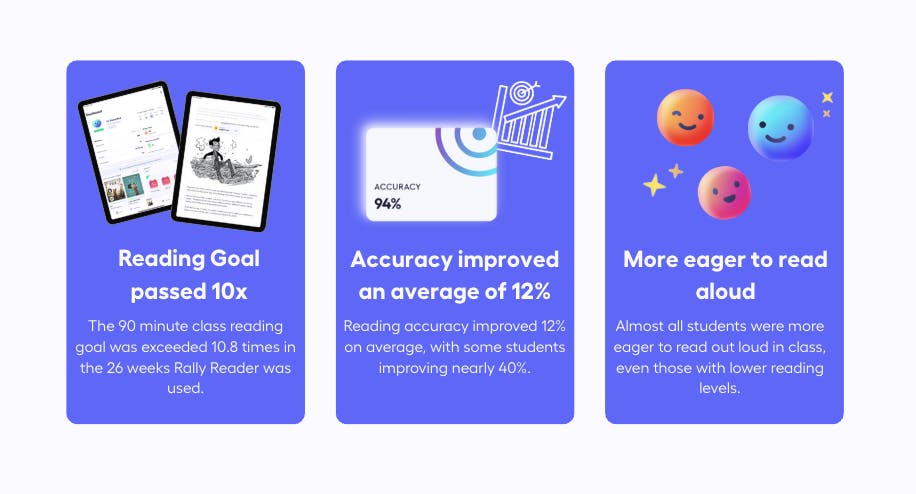
Rally Reader eliminates several barriers to literacy, including limited book access, varying levels of reading readiness, and the challenge of teacher capacity in busy classrooms by delivering a vast, adaptive digital library directly to students. Its built-in reading support reduces anxiety, builds confidence, and encourages consistent engagement. The results were striking: students in Perez’s class read more accurately, progressed faster, and surpassed their collective reading goal of 90 minutes per week more than ten times during the school year. Their success illustrates the powerful impact of accessible, student-centered literacy tools.
Education + Access = Success
The transition from learning to read to reading to learn takes place primarily in third grade. When this shift is successful, students are more likely to thrive across all subjects, setting the stage for long-term academic achievement, economic opportunity, and personal confidence. Students who struggle with this transition are disproportionately students of color, lower socioeconomic status, or students with learning differences (Zakariya, 2015). Perez’s 2023-2024 English class reflected these challenges: most students were reading below grade level due to a range of factors, including learning differences, limited English proficiency, and few opportunities to engage with books at home.
Too often, struggling readers face limited access to appropriately leveled books, which leads to frustration, disengagement, and heightened anxiety. Without a sense of agency or success, many begin to associate reading with stress rather than joy. Rally Reader disrupts this pattern in a positive way by giving students immediate access to thousands of books matched to their individual reading level and interests. This abundance of choice reduces the pressure to “catch up” in silence or secrecy, and instead promotes self-directed learning, motivation, and a sense of accomplishment.
“When students can self-select from a rich variety of books at their level, it builds confidence and motivation—key drivers of academic growth,” explains literacy expert Linda Gambrell (2011). Decades of research affirm that the right volume and variety of accessible reading materials not only improves literacy skills, but also helps students develop lifelong reading habits (Krashen, 1993). In short, Rally Reader makes reading possible and enjoyable for every student.
Strategy and Implementation
In 2023 and 2024, Rally Reader partnered with classrooms across the United States to study the impact of the literacy app’s unlimited book access, adaptive reading support, and engagement-tracking features. Educators from multiple grade levels applied to participate in the project. Selected classes agreed to use Rally Reader for 30 minutes a day, three days a week, over a 26-week period between October and May. For Eli Perez, this was an opportunity to make a tremendous difference in the literacy development of her students.
To support implementation, the Rally Reader team conducted three professional development sessions for teachers. These sessions, held in October before the intervention began and again in January and March, provided guidance on effectively using Rally Reader in the classroom and maintaining consistent student engagement.
Rally tracked individual reading time and accuracy, consolidating class data into a user-friendly teacher dashboard accessible to both Rally staff and research partners. The study also assessed user experience, student engagement, and identified areas for improvement, offering a thorough evaluation of Rally Reader’s overall effectiveness. For Perez, that effectiveness was clear. “One of Rally Reader’s most powerful impacts is supporting students in identifying and pronouncing words correctly and having them practice their reading fluency… The dashboard is helpful for me to track whether students are actively participating in their reading exercises and what words they struggle with. It’s also helpful to know what kinds of books students are drawn to.”
Perez’s students quickly embraced the freedom to choose what they read. They eagerly explored Rally Reader’s book recommendation feature and became proficient at filtering books by their own reading level. These skills gave them a sense of ownership and independence in reading. Some were so motivated, they asked for their login information so they could keep reading at home on their own time. “It was great to know students were receiving support even without constant teacher intervention.”
Results and Analysis
After using Rally Reader consistently throughout the school year, Eli Perez’s class showed a notable shift in reading behavior. Between the months of October and May, the class exceeded their goal of reading 90 minutes per week more than ten times. For a group that had previously struggled with motivation and confidence, this surge in reading volume signaled a dramatic shift—not just in performance, but in mindset. Students who were once reluctant to pick up a book were now reading regularly, often independently, and taking pride in their progress. This kind of transformation is possible when students have access to content that feels approachable, engaging, and achievable, and when teachers have the tools to monitor that engagement in meaningful ways. Rally Reader’s ability to track active reading minutes gave Perez access to measurable data she could use to set goals, identify trends, and make instructional decisions in real time.
Another encouraging trend was the stabilization of words per minute (WPM) and accuracy. Students who struggle with confidence or learning differences often rush through reading to mask their challenges, and in October, the students’ WPM outpaced their accuracy. After using Rally, Perez’s class saw a 12% increase in reading accuracy, which aligned with their WPM in a clear indication that students were slowing down, processing text more thoughtfully, and reading more fluently.
Rally Reader’s innovations gave Perez new ways to support and monitor her students. The app’s engagement tracking ensured students were reading frequently and broadly, while the built-in recording feature became a breakthrough tool. Perez used student audio recordings in IEP meetings and parent-teacher conferences to provide tangible evidence of growth—an essential layer of support that traditional assessments can’t always capture. Just as importantly, these recordings helped students hear their own progress. For many students, this was the first time they could clearly recognize their improvement, building both pride and confidence in their abilities.
Rally Reader Bridges the Gap
Adaptive support and reliable access to engaging, level-appropriate texts empowers students to grow as readers and believe in their potential. For Eli Perez’s students, Rally Reader offered more than just a library. It created a space where they could explore, learn, and succeed. “More students started volunteering to read out loud, even when they had lower reading levels,” Perez shared. “[My students’] confidence has really improved.
With limited budgets, outdated selections, and increasing difference between reading levels, traditional classroom libraries often can’t keep up with students. Educators are left trying to fill the gaps on their own. Rally Reader comes to the rescue by offering thousands of books that students can filter by interest and level, creating an accessible and inclusive reading experience for every learner.
To close the literacy gap and meet the diverse needs of today’s classrooms, schools must invest in solutions that expand access, personalize instruction, and build student confidence. Rally Reader empowers educators, engages students, and transforms reading from a source of stress into a strength. The result? More confident readers, more motivated classrooms, and a stronger foundation for lifelong literacy.
Resources:
CAST. (n.d.). Universal Design for Learning Guidelines. CAST. https://udlguidelines.cast.org/
Cornell University. (n.d.). Universal Design for Learning. Cornell University. https://teaching.cornell.edu/teaching-resources/universal-design-learning
Gambrell, L. B. (2011). Seven rules of engagement: What’s most important to know about motivation to read. The Reading Teacher, 65(3), 172-178.
Krashen, S. D. (1993). The Power of Reading: Insights from the Research. Libraries Unlimited.
Zakariya, S. B. (2015). The impact of literacy disparities on life outcomes. Educational Research Quarterly.