February 2, 2025
The Joy of Reading: Rally Reader Fuels Confidence, Academics, and Connection
Overview
When Anya Wasko’s K-2 Special Education class fell in love with cookbooks, something remarkable sparked in her students. For many, it was the first time they were genuinely excited to read. Cookbooks offer more than just recipes; they open doors to curiosity, collaboration, and cross-curricular connections to Science and Math. But Anya’s classroom library didn’t have a single one. That changed with Rally Reader. Access to over 50,000 titles (including cookbooks, classics, new hits, and more) and an AI-powered reading coach offered personalized support for Anya’s students, which allowed them to explore their expanding interests freely and confidently. "Rally makes reading so accessible, and there are so many books! It's all right there.” With that access came transformation: even Anya’s most reluctant readers were drawn in.
Literacy is built through thoughtful instruction, motivation, and repeated practice. Effective reading instruction strengthens the brain’s ability to connect letters and sounds and creates efficient pathways for learning and understanding. While there is no single perfect approach to literacy education, studies consistently emphasize the value of systematic support that builds phonological and orthographic awareness (Petscher et al., 2020). Rally Reader weaves evidence-based instruction into an engaging literacy app that motivates students to keep reading. By pairing structured literacy techniques with adaptive AI coaching, Rally supports students at every reading level and gives them the tools they need to grow. Beyond skill building, Rally helps students succeed across academic subjects, creating moments of joy, curiosity, and community for all readers.
Reading as a Foundation for All Subjects
Literacy powers learning across every subject. In Science, students interpret data and explain findings. In Math, they unpack complex word problems. In Social Studies, they analyze primary sources and construct arguments. In the Arts, they reflect, critique, and tell stories. When reading strategies are integrated across curriculum, students engage more deeply, think more critically, and retain more of what they learn (Neuhaus Education Center, 2024).
In school, authentic, cross-disciplinary reading builds stronger connections to content, classmates, and the real world. When students use high-impact literacy tools across curricula, they benefit from a consistent approach to reading and access to high-quality materials on all subjects (Aslan, 2016). Rally Reader makes it possible to bridge subjects and support every learner on their journey to becoming curious and confident readers.
Program Design and Evaluation Approach
With the wide range of reading ability in her K-2 Special Education class, Anya Wasko was eager to find a literacy tool to support her instruction. She eagerly applied to participate in Rally Reader’s 2023-2024 research partnership. Selected teachers were granted access to Rally’s extensive library of over 50,000 titles from top publishers, integrated with an adaptive AI literacy coach that provided personalized support for improving reading fluency and accuracy. Students were expected to use the app for 30 minutes a day, three days a week, over a 26-week period between October and May. Teachers and Rally Reader staff closely monitored engagement and progress throughout the school year.
To support implementation, Rally Reader hosted three professional development sessions for teachers in October, January, and March. These sessions focused on effective integration of the app into weekly literacy curricula and maintaining student engagement. Rally’s class profiles tracked reading time, accuracy, and engagement, with data made accessible to teachers, research partners, and Rally staff through teacher dashboards. The project also examined user experience, overall engagement, and areas for potential improvement, providing a comprehensive evaluation of Rally Reader’s impact on student literacy development.
Real-World Impact and Measurable Outcomes
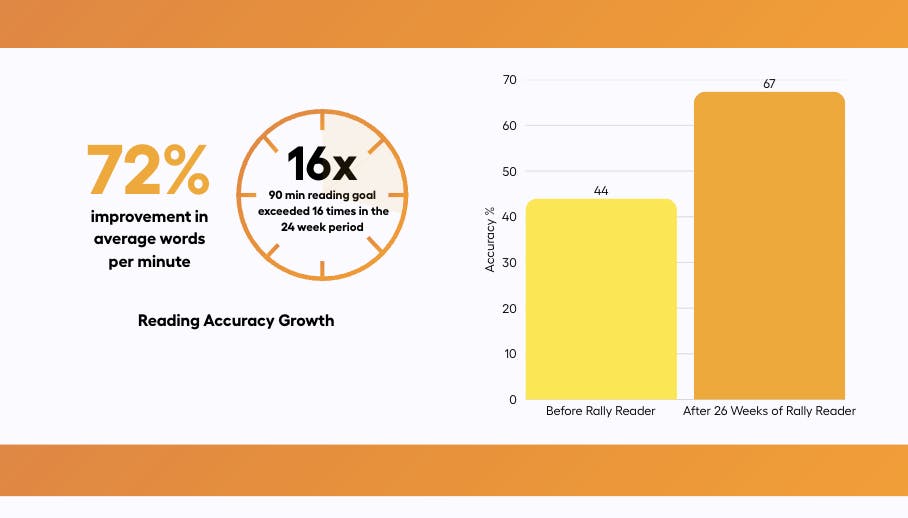
According to oral reading fluency norms established by Betts et al. (2017), second graders are expected to read an average of 50 words per minute (WPM) in the fall and 90 WPM by spring. When Anya Wasko introduced Rally Reader into her Special Education second-grade classroom, her students were averaging just 18 WPM—well below the national benchmark. But by May, their average had climbed to 31 WPM. While still under the national spring target, this marks a 72% improvement and significant rate of progress. Many of Anya’s students more than doubled their reading speed, underscoring Rally Reader’s ability to accelerate fluency growth, even for students with additional learning needs.
Fluency is more than speed—it's about accuracy, too. Alongside gains in WPM, Anya’s students also improved their reading accuracy by 23%, which stabilized overall fluency growth. These combined improvements reflect not just faster reading, but stronger readers.
Beyond the data, Rally Reader made a noticeable difference in how students felt about themselves as readers. Anya saw a shift in engagement and self-belief. “When students tell me they can’t read, I love that I can pull up recordings of them using Rally. I ask them to listen and then tell me again if they think they can’t read. That’s been super successful!” The app’s built-in recording feature became an invaluable tool for tracking student growth and supporting IEP meetings and parent-teacher conferences, in addition to boosting student confidence. Hearing their own progress helped students take ownership of their learning and believe in their potential.
Conclusion
Anya Wasko’s students didn’t just read cookbooks—they talked about them, shared favorite recipes, and sparked each other’s curiosity. That spark soon spread to other genres and subjects. “There’s definitely been an increase in students exploring new genres,” Anya noted. “And Rally has been really helpful for students who have interests that aren’t represented in our classroom library.” With the freedom to choose texts that reflect those expanding interests, students began to see reading not as a task, but a joyful experience.
Enthusiasm for reading fosters more than academic growth; it builds a culture of readers who learn together. As students share books, ideas, and discoveries, reading becomes a collectively exciting part of the classroom experience. Stronger readers perform better across all subjects, from Science and Math to Art and Social Studies, and they consistently achieve higher test scores. But perhaps more importantly, they build the confidence and curiosity to keep exploring.
Rally Reader supports this growth by making reading accessible, relevant, and fun. Its expansive digital library and adaptive features provide students with the guidance they need and the freedom they crave. With real-time feedback, cross-curricular content, and engaging tools that promote independent reading, Rally Reader helps students grow not just as individuals, but as a community of learners.
Resources
Aslan, Y. (2016). The Effect of Cross-Curricular Instruction on Reading Comprehension. Universal
Journal of Educational Research, 4(8), 1797-1801.
Betts, J., Pickart, M., & Heistad, D. (2017). Oral reading fluency norms: A valuable assessment tool for educators (Technical Report No. 1702). Behavioral Research and Teaching, University of Oregon. https://www.brtprojects.org/wp-content/uploads/2017/10/TechRpt_1702ORFNorms_Fini.pdf
Neuhaus Education Center. 2024. Literacy Across Curriculum: Integrating Reading and Writing in Every Subject. Neuhaus Education Center.
Petscher Y, Cabell SQ, Catts HW, Compton DL, Foorman BR, Hart SA, Lonigan CJ, Phillips BM, Schatschneider C, Steacy LM, Terry NP, Wagner RK. (2020) How the Science of Reading Informs 21st-Century Education. The National Library of Medicine.
Scholastic. (n.d.). The power of reading choice, time, and pleasure. https://teacher.scholastic.com/education/classroom-library/pdfs/The-Power-of-Reading-Choice.pdf